A sparged stirred tank bioreactor (STBR) is a common type of bioreactor used in industrial and laboratory-scale applications for growing microorganisms, cells, or tissues in controlled environments. The key components that define this system are the stirring mechanism and the sparging system.
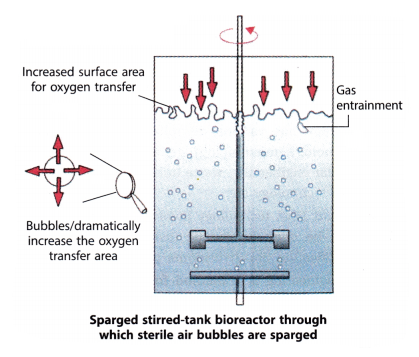
Here’s a breakdown of the terms and how the system works:
1. Sparging:
- Sparging refers to the process of injecting gas (like air or oxygen) into the bioreactor, usually through a sparger (a porous device or a tube with small holes).
- The gas creates bubbles that rise through the liquid, helping to mix the contents, deliver oxygen, and remove carbon dioxide.
- This is particularly important in aerobic processes where oxygen is needed for microbial or cell growth.
2. Stirring:
- Stirring is the mechanical agitation provided by an impeller inside the bioreactor. The impeller helps mix the contents, ensuring uniform distribution of nutrients, temperature, and gas, as well as preventing the formation of dead zones where mixing is poor.
- Stirring also helps to keep the cells in suspension, preventing settling.
3. Purpose of the Stirred Tank Bioreactor:
- The main function is to provide a controlled environment for biochemical processes, such as fermentation or cell culture.
- The reactor needs to maintain optimal conditions for growth (temperature, pH, dissolved oxygen, etc.) and efficient mixing of the cells, nutrients, and gases.
4. Key Features of a Sparged Stirred Tank Bioreactor:
- Gas-Liquid Interaction: The sparging system ensures proper gas distribution and can be adjusted for different oxygen requirements.
- Agitation: The impeller helps mix the medium, preventing the formation of gradients in nutrient or oxygen concentrations.
- Control Systems: Temperature, pH, dissolved oxygen (DO), and sometimes shear stress are continuously monitored and adjusted for optimal growth.
Applications:
- Fermentation: Production of products like ethanol, antibiotics, or enzymes.
- Cell culture: Growing mammalian or insect cells for biotechnology applications.
- Biotransformation: Converting raw materials to valuable products with microbial or enzymatic processes.
Common Challenges:
- Shear Stress: The mechanical agitation can cause shear stress, which might damage delicate cells.
- Oxygen Transfer Efficiency: In large-scale reactors, the gas transfer efficiency can become a limiting factor, which requires careful optimization of sparging and stirring.